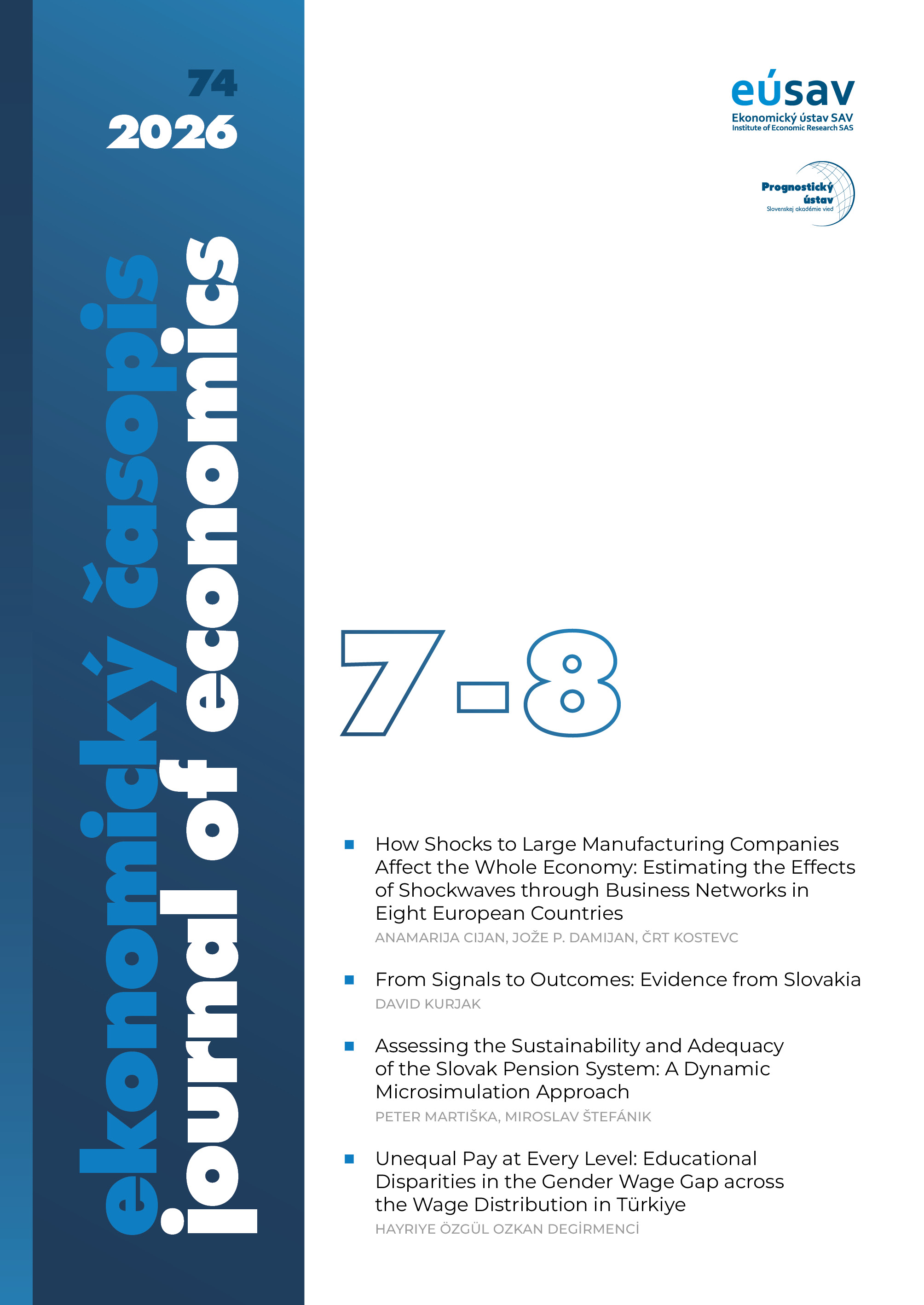
Assessing the Sustainability and Adequacy of the Slovak Pension System: A Dynamic Microsimulation Approach
DOI:
https://doi.org/10.31577/ekoncas.2026.07-08.03Keywords:
microsimulation, sustainability, adequacy, Slovakia, pension systemAbstract
This paper develops and applies a dynamic microsimulation pension module to assess the sustainability and adequacy of the Slovak pension system. The module links simulated individual labour market histories to pension entitlements and applies the statutory rules of the Slovak first pillar to old age, early old age, disability and survivor pensions. The results are evaluated against official medium- and long-term pension projections. The model broadly reproduces the main aggregate expenditure trends for the dominant pension categories and provides a useful complementary perspective to existing projection tools. Its main added value lies in the ability to analyse pension outcomes at the individual level. The results show that aggregate adequacy indicators can mask important differences by sex, age and retirement pathway. In particular, the relative position of older pensioners weakens over time as pensions in payment are indexed to prices rather than wages, while gender differences in first pillar adequacy are shaped by labour market histories and second pillar participation. The comparison with official projections also highlights methodological differences in the treatment of disability pensions, where individual level modelling can represent transitions into old age pensions more explicitly. Policy simulations illustrate the trade-off between fiscal sustainability and pension adequacy. Reforms affecting the pension point value or the interaction with the funded pillar have gradual but sizeable long-run effects, while unifying the retirement age of men and women produces limited aggregate fiscal effects but meaningful distributional consequences. The paper concludes that dynamic microsimulation is best understood as a complement to aggregate pension models: it does not replace official fiscal projections, but extends them by revealing distributional mechanisms that are important for evaluating pension reforms and the system setting as a whole.
Downloads
Published
Issue
Section
License
Copyright (c) 2026 Peter Martiška, Miroslav Štefánik

This work is licensed under a Creative Commons Attribution-NonCommercial-NoDerivatives 4.0 International License.